
Color legend plain property method
Twelve of the 44 functions take parameters that change their curve. A, B, C and D are numbers from 0 to 1 that most often place a point the curve sits at or passes through; N is a whole number, the order of a polynomial. Most of these functions come from Golan Levin’s collection of shaping functions, and two are Bézier curves. Names are colored by what they are: a property or a method.
Setting parameters
A function created by its class has its parameters as properties:
var seat = new CubicDoubleSeat { A = 0.4f, B = 0.6f };

float y = seat.CalculateOutput(0.4f); // 0.6: the curve is flat at (A, B)
ShapingFunctionFactory.Create returns a BaseShapingFunction, so code that doesn’t know the class
reaches the parameters through the interfaces that hold them:
BaseShapingFunction fn = ShapingFunctionFactory.Create(id);

if (fn is IOneParameter one) one.A = 0.4f;
if (fn is ITwoParameters two) two.B = 0.6f;
if (fn is INOrder order) order.N = 3;
The interfaces of A to D are nested: ITwoParameters extends IOneParameter, IThreeParameters
extends ITwoParameters, and IFourParameters extends IThreeParameters, so a function that has B has A, and
one that has D has all four. INOrder stands apart: DoubleOddPolynomialSeat has it with A and B,
DoublePolynomialSigmoid alone.
The curve follows a change at once: the next CalculateOutput uses the new values, so parameters can
be animated too. Each instance has its own parameters, and the factory creates a new instance every call, so two users
of one ID never change each other’s curve.
Parameter interfaces
| Property | Type | Description |
|---|---|---|
IOneParameter.A |
float |
The first parameter. Every parametric function but DoublePolynomialSigmoid has it. |
ITwoParameters.B |
float |
The second. The Béziers, the elliptical curves, the cubic and odd polynomial seats, and the parabola through a point have it. |
IThreeParameters.C |
float |
The third. Only BezierCubic has it, through IFourParameters. |
IFourParameters.D |
float |
The fourth. Only BezierCubic has it. |
INOrder.N |
int |
The order. DoubleOddPolynomialSeat and DoublePolynomialSigmoid have it. |
A function says which it has through ParameterCount, HasVariableOrder and Parametric,
see the catalog page.
Ranges, defaults and NaN
A parameter is clamped to its range when it is set, without an exception: set A to 2 and it reads back 1. The ranges:
- A to D: 0 to 1. Every A but those of the two Béziers is kept within 0.00001 to 0.99999 instead, because those
curves divide by A or by 1 − A. The margin is
ParameterEpsilon. - N: at least 1.
DoubleOddPolynomialSeatalso keeps N at most 1,073,741,823, so its exponent, 2N + 1, fits in anint.
NaN would pass through a clamp and spoil every output after it, so setting A to D to NaN throws
ArgumentOutOfRangeException and the parameter keeps the value it had.
Parameters start at the bottom of their range: A at 0.00001, or 0 for the Béziers, B to D at 0 and N at 1. At their defaults, the parametric functions are plain curves:
| Function | At its defaults |
|---|---|
BezierCubic, BezierQuadratic, DoublePolynomialSigmoid |
Linear |
ExponentialDoubleSeat, LogisticSigmoid |
Linear, to within 0.00001 |
CircularDoubleSeat, EllipticalDoubleSeat |
CircularEaseIn, to within 0.00001 |
CircularDoubleSigmoid, EllipticalDoubleSigmoid |
CircularEaseOut, to within 0.0003 |
CubicDoubleSeat, DoubleOddPolynomialSeat |
CubicEaseIn, to within 0.00001 |
QuadraticThroughAGivenPoint |
QuadraticEaseIn, to within 0.00001 |
Set the parameters before using one of these functions, and show a function with its parameters in a picker.
Seats
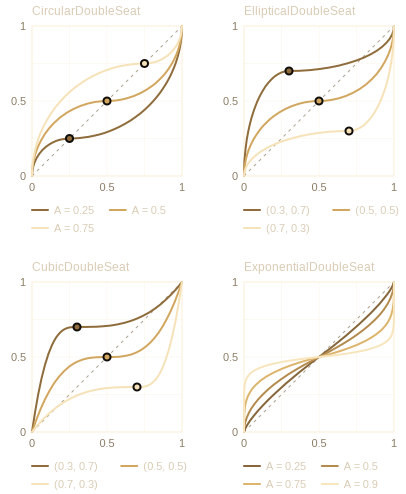
A seat rises, levels out at a point and rises again: a movement with a pause in the middle, or a value that lingers near one level. The seats differ in where they level out and how they start and end.
CircularDoubleSeat
Two quarter circles that meet at (A, A), where the curve is flat. It starts and ends upright. The seat is always on the diagonal: for a seat at another height, use the elliptical or the cubic seat.
| Property | Type | Description |
|---|---|---|
A |
float |
Where the two arcs meet: the curve is flat at (A, A). 0.00001 to 0.99999; 0.00001 by default. |
EllipticalDoubleSeat
Two quarter ellipses that meet flat at (A, B), so the seat can be anywhere. It starts and ends upright, like the circular seat, which it is when B equals A.
| Property | Type | Description |
|---|---|---|
A |
float |
The x of the seat. 0.00001 to 0.99999; 0.00001 by default. |
B |
float |
The y of the seat. 0 to 1; 0 by default. |
CubicDoubleSeat
Two cubics that meet flat at (A, B). Unlike the elliptical seat, it leaves (0, 0) and comes into (1, 1) at a finite
slope, 3B / A at the start and 3(1 − B) / (1 − A) at the end, so it reads as a softer pause.
DoubleOddPolynomialSeat widens the pause with its order, see the order N.
| Property | Type | Description |
|---|---|---|
A |
float |
The x of the seat. 0.00001 to 0.99999; 0.00001 by default. |
B |
float |
The y of the seat. 0 to 1; 0 by default. |
ExponentialDoubleSeat
Two power curves, (2x)1 − A / 2 and its mirror, that meet at the middle, (0.5, 0.5), with a slope of 1 − A. A sets how flat the middle is: 0 is the straight line, and as A nears 1 the curve becomes a plateau at 0.5 with a jump at each end. It starts and ends upright for any A above 0.
| Property | Type | Description |
|---|---|---|
A |
float |
How flat the middle is. 0.00001 to 0.99999; 0.00001 by default, a straight line. |
Sigmoids
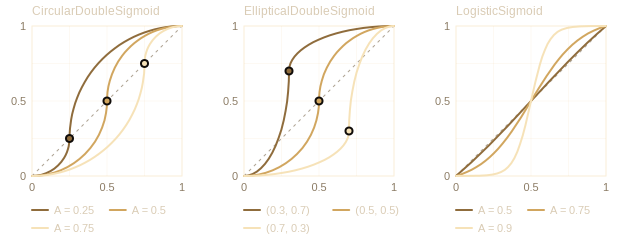
A sigmoid is an S: slow, fast, slow, like an ease in-out whose fast point or steepness can be chosen. The circular and elliptical sigmoids are the seats turned on their side: they are flat at the ends and stand upright where their arcs meet.
CircularDoubleSigmoid
Two quarter circles that meet upright at (A, A). It starts and ends flat.
| Property | Type | Description |
|---|---|---|
A |
float |
Where the two arcs meet: the curve is upright at (A, A). 0.00001 to 0.99999; 0.00001 by default. |
EllipticalDoubleSigmoid
Two quarter ellipses that meet upright at (A, B). It starts and ends flat, and is the circular sigmoid when B equals A.
| Property | Type | Description |
|---|---|---|
A |
float |
The x of the upright point. 0.00001 to 0.99999; 0.00001 by default. |
B |
float |
The y of the upright point. 0 to 1; 0 by default. |
LogisticSigmoid
The logistic function, the S of population growth and of neural networks, scaled to run exactly from 0 to 1. It always crosses the middle, (0.5, 0.5); A sets how steeply. At A = 0.5 it crosses at 1.08 times the speed of Linear, at 0.75 at 1.66 times and at 0.9 at 4.5 times, and as A nears 1 it becomes a step at 0.5. It is computed in double precision, which keeps it smooth when A is small.
| Property | Type | Description |
|---|---|---|
A |
float |
How steep the S is: the logistic steepness is 1 / (1 − A) − 1. 0.00001 to 0.99999; 0.00001 by default, a straight line. |
The order N
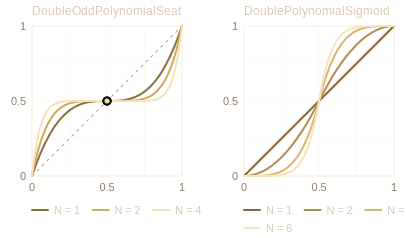
Two functions take an order N, the power of the polynomials their two halves are made of.
DoubleOddPolynomialSeat
The cubic seat with any odd power: its halves are powers of 2N + 1, so N = 1 is CubicDoubleSeat exactly, and
each higher order widens the flat part around (A, B). A very high N turns the curve into a plateau at B, with a jump at
each end. Orders from 1 to about 20 are the useful ones.
| Property | Type | Description |
|---|---|---|
A |
float |
The x of the seat. 0.00001 to 0.99999; 0.00001 by default. |
B |
float |
The y of the seat. 0 to 1; 0 by default. |
N |
int |
The order: the halves are powers of 2N + 1. 1 to 1,073,741,823; 1 by default. |
DoublePolynomialSigmoid
The ease in-out of any power: its halves are (2x)N / 2 and its mirror. N = 1 is Linear, and N = 2 to 5
are exactly QuadraticEaseInOut to QuinticEaseInOut. Higher orders sharpen it toward a step at
0.5, and orders from 1 to about 10 are the useful ones.
| Property | Type | Description |
|---|---|---|
N |
int |
The order: the halves are powers of N. At least 1; 1 by default. |
A parabola through a point
QuadraticThroughAGivenPoint
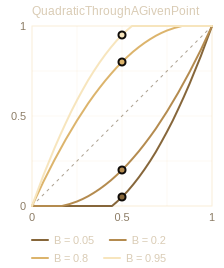
The parabola through (0, 0), (A, B) and (1, 1). With the point below the diagonal it bends like an ease in, above it like an ease out. Where the parabola would leave 0 to 1 on its way, the curve is held at 0 or at 1 instead, so it never goes back: with A = 0.5 and B = 0.05 it stays at 0 until x = 0.44.
| Property | Type | Description |
|---|---|---|
A |
float |
The x of the point. 0.00001 to 0.99999; 0.00001 by default. |
B |
float |
The y of the point. 0 to 1; 0 by default. |
Bezier curves
The two Béziers run from (0, 0) to (1, 1) and are shaped by control points: the curve leaves (0, 0) heading for the first control point and comes into (1, 1) from the direction of the last. For each input x, the output is the y of the point of the curve whose x is x. All four parameters are 0 to 1 and 0 by default, which makes both Béziers straight lines until they are set, and so does any set of control points on the diagonal.
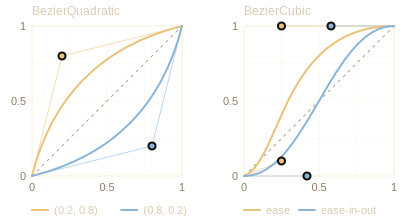
ease and ease-in-out.BezierQuadratic
One control point, (A, B).
| Property | Type | Description |
|---|---|---|
A |
float |
The x of the control point. 0 to 1; 0 by default. |
B |
float |
The y of the control point. 0 to 1; 0 by default. |
BezierCubic
Two control points, (A, B) and (C, D): the curve of CSS’s cubic-bezier(x1, y1, x2, y2) and of the curve editors of
most animation tools, with the same four numbers in the same order.
// CSS's ease: cubic-bezier(0.25, 0.1, 0.25, 1)
var ease = new BezierCubic { A = 0.25f, B = 0.1f, C = 0.25f, D = 1.0f };
| CSS | A | B | C | D |
|---|---|---|---|---|
ease |
0.25 | 0.1 | 0.25 | 1 |
ease-in |
0.42 | 0 | 1 | 1 |
ease-out |
0 | 0 | 0.58 | 1 |
ease-in-out |
0.42 | 0 | 0.58 | 1 |
CSS lets the y of a control point go below 0 or above 1 for an overshoot; here B and D are clamped to 0 to 1 like the others, so a Bézier never overshoots. For an overshoot, use Back or Elastic. Keeping the x of both control points within 0 to 1 means every x has exactly one point on the curve, which the function finds with Newton steps kept safe by bisection.
| Property | Type | Description |
|---|---|---|
A |
float |
The x of the first control point: CSS’s x1. 0 to 1; 0 by default. |
B |
float |
The y of the first control point: CSS’s y1. 0 to 1; 0 by default. |
C |
float |
The x of the second control point: CSS’s x2. 0 to 1; 0 by default. |
D |
float |
The y of the second control point: CSS’s y2. 0 to 1; 0 by default. |