
Color legend plain property method
Winds up about the start, snaps across the middle and wobbles to rest on the end.
A class in the category ShapingFunctionCategory.Elastic. It derives from BaseShapingFunction and has its members too: CalculateOutput gives the curve. The curves page shows it in context, with the rest of its family.
Names are colored by what they are: a property or a method; values and fields keep the plain color.
The curve
| Property | Value |
|---|---|
Id |
ShapingFunctionId.ElasticEaseInOut, number 14 |
Category |
ShapingFunctionCategory.Elastic |
Name |
"Elastic EaseInOut" |
Order |
null |
ParameterCount |
0 |
HasVariableOrder |
false |
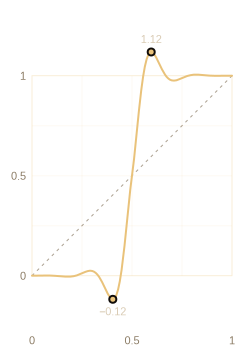
For an input x from 0 to 1, the output is −220x − 10 sin((20x − 11.125)·2π/4.5) / 2 for x below 0.5, and 210 − 20x sin((20x − 11.125)·2π/4.5) / 2 + 1 from 0.5, and exactly 0 and 1 at the ends.
It dips to −0.12 at x = 0.40 and overshoots to 1.12 at x = 0.60, with smaller swings before and after. Its period is its own, so its halves are not ElasticEaseIn and ElasticEaseOut squeezed.
Methods
ElasticEaseInOut() →
ElasticEaseInOut() · Creates the curve. ShapingFunctionFactory.Create creates the same from ShapingFunctionId.ElasticEaseInOut.