
Color legend plain property method
Every curve of the library starts at 0 and ends at 1; what differs is the way between. The pictures on this page put
the input across and the output up, both from 0 to 1, with Linear as a dashed diagonal. Above the diagonal a
curve is ahead of a constant speed, below it behind, and the steeper the curve, the faster the movement. Every picture
is drawn from the library’s own outputs.
In, out and in-out
Most families come in threes:
- Ease in starts slowly and speeds up: still at the start, fast at the end.
- Ease out starts fast and slows down: fast at the start, still at the end.
- Ease in-out does both: still at both ends, fastest in the middle.
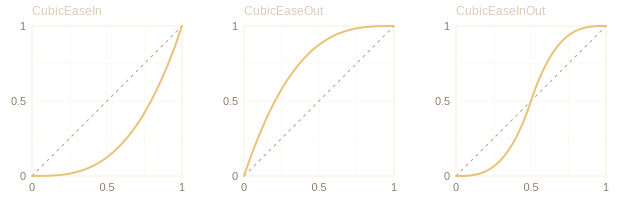
The three are one shape used three ways. An ease out is its ease in played backwards, out(x) = 1 − in(1 − x), and
the first half of an ease in-out is the ease in at double speed and half height, the second half the ease out. Every
ease in-out is symmetric about its middle: it passes 0.5 at 0.5, and is as far below 0.5 a little before the middle as
it is above it a little after. Back and Elastic have constants of their own for their in-outs, which are symmetric too
but aren’t made of their eases in and out.
The names say where the easing is, not where the speed is. A rule that works for most movements:
- What arrives, such as a panel sliding in or a camera coming to rest, eases out: it comes in fast and settles.
- What leaves, such as a panel sliding out, eases in: it gathers speed as it goes.
- What moves from one rest to another by itself, such as a door or a camera between two views, eases in and out.
Polynomial curves
QuadraticEaseIn is x², CubicEaseIn x³, QuarticEaseIn x⁴ and QuinticEaseIn x⁵, and
Linear is x itself. The higher the power, the longer the slow part and the sharper the fast part: an ease
in of power N ends at N times the speed of Linear, and an ease in-out of power N crosses the middle at N times that
speed.
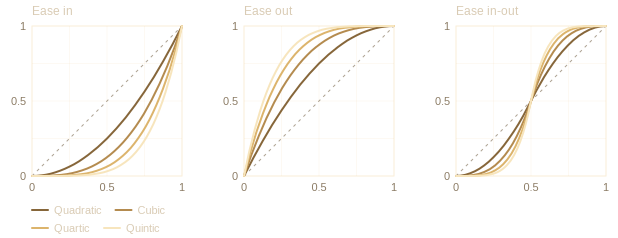
| Power | Ease in | Ease out | Ease in-out | Ease in at the middle |
|---|---|---|---|---|
| 1 | Linear |
0.5 | ||
| 2 | QuadraticEaseIn |
QuadraticEaseOut |
QuadraticEaseInOut |
0.25 |
| 3 | CubicEaseIn |
CubicEaseOut |
CubicEaseInOut |
0.125 |
| 4 | QuarticEaseIn |
QuarticEaseOut |
QuarticEaseInOut |
0.0625 |
| 5 | QuinticEaseIn |
QuinticEaseOut |
QuinticEaseInOut |
0.031 |
Quadratic speeds up evenly, like something falling; cubic is the usual choice for interface movement; quartic and
quintic hold still longer and move more abruptly. DoublePolynomialSigmoid is the ease in-out of any power,
set by its order N, see the order N.
A function’s Order is the degree of the polynomials its curve is made of: 1 for Linear, 2 to 5 for these
families, and 6 for the Blinn-Wyvill curve below. Back, Bounce and the Béziers have an order too, and the curves that
aren’t polynomials have none.
Sine, circular and exponential
Three more families of eases, from the gentlest to the most abrupt:
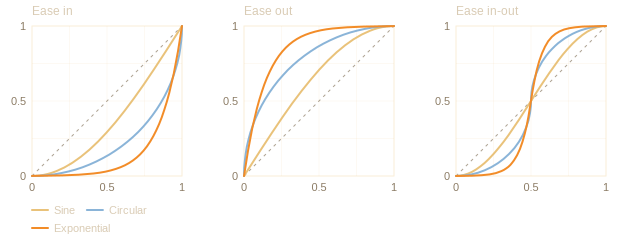
- Sine follows a quarter of a cosine wave:
SineEaseInis 0.29 at the middle, closer to Linear than any other ease in. It suits movements that should barely feel eased: a slow pan, a light that breathes, a fade. - Circular curves are quarter circles.
CircularEaseInstarts like half a quadratic and steepens to vertical at the end, covering nearly half its way in the last tenth of the time; the in-out passes its middle straight up, a snap. - Exponential curves double every tenth of the way:
ExponentialEaseInis only 0.03 at the middle, and covers 90% of its way in the last third of the time. Its formula is 0.001 rather than 0 at the start, so the curve steps from exactly 0 to 0.001 just after it, andExponentialEaseOutsteps from 0.999 to exactly 1 just before the end. The steps can’t be seen, but a test such asoutput > 0is true almost at once.
BlinnWyvillCosineApproximation, the one function of the Hexic category, is a polynomial of degree 6
that stays within 0.003 of SineEaseInOut without computing a cosine.
Back
The back curves overshoot by 10%. BackEaseIn first pulls back below the start, as a hand draws back
before a throw. BackEaseOut passes the end and comes back to it, and BackEaseInOut does both.
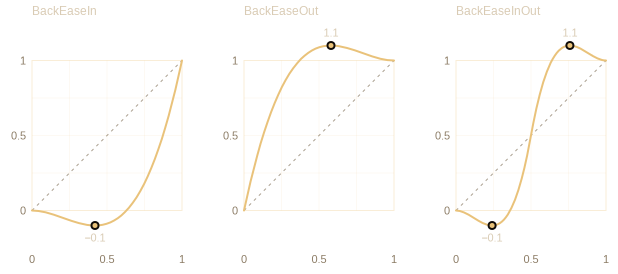
A small overshoot makes a movement feel springy and weighty: a button that pops up, a panel that drops into place, an icon that grows in. The output leaves 0 to 1, so the value leaves its range: a panel moving 300 pixels passes its place by 30, and an opacity eased with Back reaches 1.1. Interpolate without clamping, and clamp values that have limits.
Elastic
The elastic curves wobble like a spring. ElasticEaseOut snaps past the end by 37%, swings back to
0.87, then to 1.05, each swing about a third of the last, and settles. ElasticEaseIn is the same played
backwards: a spring winding up. ElasticEaseInOut winds up, snaps across and wobbles to rest, with swings of 12%.
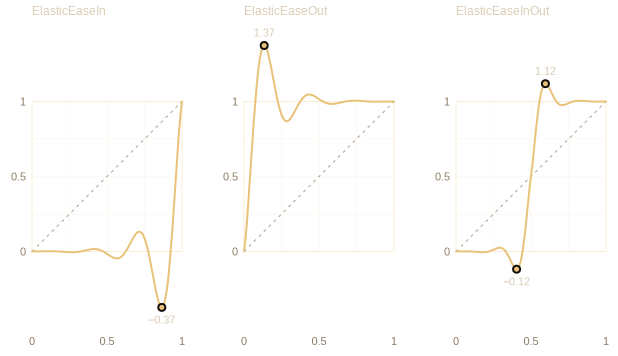
An overshoot of a third is a lot: a scale goes to 1.37 times its size, and a position far past its place. Elastic suits short, playful movements, such as a hit reaction or a jelly-like pickup, better than long ones.
Bounce
The bounce curves never leave 0 to 1 but fall back on the way, like a ball dropped onto the floor.
BounceEaseOut reaches the end at 36% of the time, falls back to 0.75, 0.9375 and 0.984 between ever shorter
bounces, and rests on the end at 1. BounceEaseIn is the same played backwards, with growing hops off the
start, and BounceEaseInOut both.
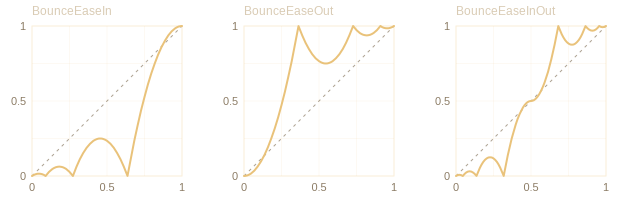
Because a bounce never passes 1, a thing that lands with BounceEaseOut never sinks through the floor it lands
on, and the curve keeps an opacity or a volume within its range.
The parametric curves
Twelve functions take parameters that change their shape. Most come from Golan Levin’s collection of shaping functions; the parameters A to D usually place a point the curve sits at or passes through.
| Shape | Functions |
|---|---|
| Seats: a rise, a pause, a rise | CircularDoubleSeat, EllipticalDoubleSeat, CubicDoubleSeat, DoubleOddPolynomialSeat, ExponentialDoubleSeat |
| Sigmoids: an S of a chosen steepness or middle | CircularDoubleSigmoid, EllipticalDoubleSigmoid, LogisticSigmoid, DoublePolynomialSigmoid |
| A parabola through a chosen point | QuadraticThroughAGivenPoint |
| Bézier curves, as in CSS and animation editors | BezierQuadratic, BezierCubic |
Their parameters start at the bottom of their range, which makes most of them a plain curve, Linear or one of the eases, until they are set. The parameters page shows each with pictures.
Choosing a curve
| For | Try | Why |
|---|---|---|
| A panel, a menu or a message sliding in | CubicEaseOut, QuarticEaseOut |
A fast arrival and a soft stop |
| The same sliding out | CubicEaseIn |
It gathers speed as it leaves |
| A camera moving between two views | SineEaseInOut, CubicEaseInOut |
No jolt at either end |
| A slow pan, a breathing light, a fade | SineEaseInOut, SineEaseOut |
Eased, but barely |
| A button or an icon that pops | BackEaseOut |
A 10% overshoot reads as springy |
| Something dropped onto the floor | BounceEaseOut |
Bounces without sinking below the floor |
| A wobble, a spring, a hit reaction | ElasticEaseOut |
A big overshoot that dies away |
| A movement with a pause in the middle | CubicDoubleSeat, EllipticalDoubleSeat |
The pause can sit at any point |
| A curve copied from CSS or an animation tool | BezierCubic |
The same four numbers as cubic-bezier() |
| A constant speed: a conveyor, a progress bar | Linear |
No easing at all |
A sound that fades with distance is a curve too: the positional sound page of the audio docs shapes it with these functions.