
Color legend plain property method
Noise gives a smooth value for every point of a plane: close points have close values, far points unrelated ones. Terrain heights, caves, biomes, ore veins and wind all start from it. Both noise types here are pure functions of their seed and the point, with no state, no table and no period, so any region of an endless world can be sampled in any order, from any thread, and gives the same values every time and on every machine. Names are colored by what they are: a property or a method; values and fields keep the plain color.
Gradient noise
GradientNoise is one layer of Perlin-style gradient noise. The plane is cut into square cells 1 unit wide,
each corner of a cell gets a direction hashed from the seed and the corner, and Sample blends the four
corners of its cell smoothly. The values go from −1 to 1, and are 0 at every integer point. Scale the coordinates to
choose how large the features are:
var wind = new GradientNoise(world.Fork("wind").Seed);

double v = wind.Sample(x / 25.0, y / 25.0); // cells 25 units wide
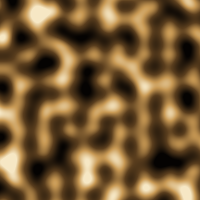
One layer alone looks soft and regular, blobs of about one size. For most terrain, use fractal noise.
GradientNoise is a small read-only struct, cheap to copy and to keep in a field. default(GradientNoise) is the same
noise as new GradientNoise(0).
GradientNoise properties
| Property | Type | Description |
|---|---|---|
Seed |
ulong |
Read-only. The seed the noise was created with. |
MaxCoordinate |
double |
Constant. 2^40, the largest x and y, either sign, that Sample takes. |
GradientNoise methods
| Method | Description |
|---|---|
GradientNoise(ulong seed) |
Creates the noise of the seed. Any value works, and different seeds give unrelated fields. |
Sample(double x, double y) |
The noise at the point, from −1 to 1. 0 at integer points. Throws ArgumentOutOfRangeException for a coordinate that is NaN, infinite or beyond MaxCoordinate. |
Fractal noise
FractalNoise adds up several layers of gradient noise, called octaves, each finer and fainter than the one
before (fractal Brownian motion, or fBm). The first octave sets the large shapes and the others add detail to them. The
sum is scaled to stay from −1 to 1.
// FractalSettings.Default: four octaves, features about 32 units across
var height = new FractalNoise(world.Fork("height").Seed);

double h = height.Sample(x, y); // x and y in world units
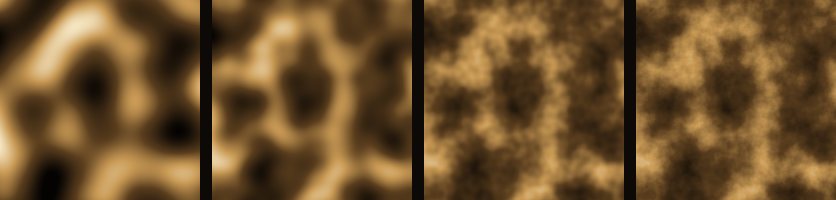
Each octave has its own seed and is shifted by a fraction of a cell, so the octaves never share their integer points: there is no grid of zeros, as there would be with one noise stacked on itself at doubled frequencies. A sample costs one gradient sample per octave.
FractalNoise is immutable and thread-safe: build it once, when the world is made, and sample it from anywhere.
FractalNoise properties
| Property | Type | Description |
|---|---|---|
Seed |
ulong |
Read-only. The seed the noise was created with. Octave i is seeded with StableHash.Combine(Seed, i). |
Settings |
FractalSettings |
Read-only. The settings the noise was created with. |
MaxOctaves |
int |
Constant. 16, the most octaves a noise can have. |
FractalNoise methods
| Method | Description |
|---|---|
FractalNoise(ulong seed) |
Creates the noise of the seed with FractalSettings.Default. |
FractalNoise(ulong seed, FractalSettings settings) |
Creates the noise of the seed with those settings. Throws ArgumentNullException for null settings, and ArgumentOutOfRangeException for settings out of range, see settings. |
Sample(double x, double y) |
The noise at the point in world units, from −1 to 1. Throws ArgumentOutOfRangeException for a coordinate that is NaN or infinite, or that the highest octave would sample beyond GradientNoise.MaxCoordinate. |
Settings
FractalSettings holds the four numbers that shape a fractal noise. It is a record of plain data, so it can sit
in a settings file next to the world seed, and two settings with the same values are equal. Change it with with:
var settings = FractalSettings.Default with { Frequency = 1.0 / 100, Octaves = 6, Gain = 0.45 };
var mountains = new FractalNoise(world.Fork("mountains").Seed, settings);
- Frequency sets the size of the large shapes: the cells per world unit of the first octave. 1/32 gives features about 32 units across; a higher frequency gives smaller ones.
- Octaves sets how much detail there is. Each octave adds a finer layer and costs one more sample.
- Lacunarity sets how much finer each octave is than the one before: 2 doubles the frequency each time.
- Gain sets how much fainter each octave is than the one before, also called persistence: 0.5 halves it each time. Lower is smoother, higher is rougher.
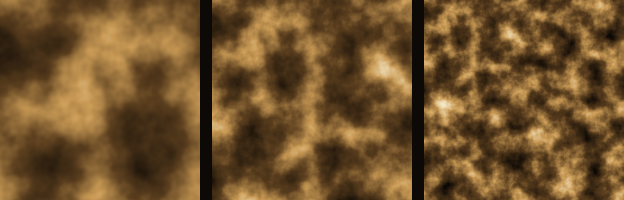
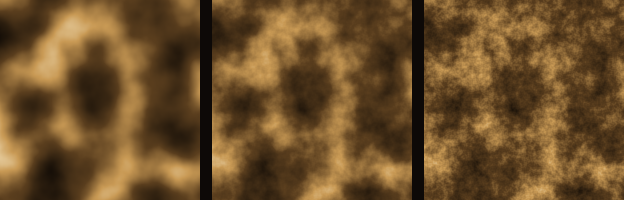
The FractalNoise constructor checks the settings, and throws ArgumentOutOfRangeException for a frequency,
lacunarity or gain that isn’t a finite number above 0, or for octaves outside 1 to MaxOctaves.
FractalSettings properties
| Property | Type | Description |
|---|---|---|
Default |
FractalSettings |
Static. The settings below at their defaults, one shared instance. |
Frequency |
double |
Init-only. The cells per world unit of the first octave. 1.0 / 32 by default: features about 32 units across. |
Octaves |
int |
Init-only. The number of octaves, 1 to MaxOctaves. 4 by default. |
Lacunarity |
double |
Init-only. The frequency of each octave over that of the one before. 2 by default. |
Gain |
double |
Init-only. The amplitude of each octave over that of the one before. 0.5 by default. |
The range in practice
Both noise types return values from −1 to 1, but they rarely come near the ends. Over 200 000 random points:
| Noise | Half of the values within | 90 % within | 98 % within |
|---|---|---|---|
GradientNoise |
±0.22 | ±0.51 | ±0.66 |
FractalNoise, 4 octaves (the default) |
±0.13 | ±0.31 | ±0.42 |
FractalNoise, 6 octaves |
±0.12 | ±0.30 | ±0.40 |
More octaves narrow the range, because independent layers partly cancel out. The values average about 0, so a test
against 0 opens about half of the plane. Choose thresholds from the table: with the default settings, a test
against 0.8 is almost never true. Where something needs the whole range, such as a color ramp, stretch the values,
for example with Math.Clamp(v / 0.45, -1, 1).
Thresholds
A threshold turns noise into shapes. Caves are open where the noise is above a value: with the default frequency and five octaves, above 0.05 opens about 40 % of the cells, in winding pockets. Lower the threshold for more open space, raise it for less.
var caves = new FractalNoise(world.Fork("caves").Seed, FractalSettings.Default with { Octaves = 5 });

for (var y = 0; y < height; y++)
for (var x = 0; x < width; x++)
    map[x, y] = caves.Sample(x, y) > 0.05 ? Tile.Floor : Tile.Rock;
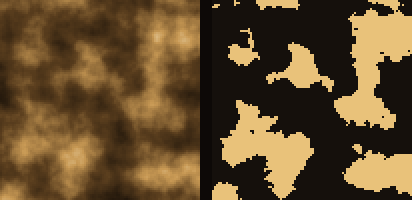
Several bands of one noise give several kinds of ground, and a second noise with its own fork adds a second axis, such as moisture next to height:
var height = new FractalNoise(world.Fork("height").Seed);
var moisture = new FractalNoise(world.Fork("moisture").Seed);

var h = height.Sample(x, y);
var m = moisture.Sample(x, y);

var biome = h < -0.15 ? Biome.Water
          : h > 0.25 ? Biome.Mountain
          : m > 0.1 ? Biome.Forest
          : Biome.Grass;
Coordinates
GradientNoise.Sample takes any coordinates up to MaxCoordinate, 2^40 or about
1.1 × 10^12, either sign. Beyond it, a double keeps too few digits after the point for smooth noise, so Sample throws
ArgumentOutOfRangeException instead of returning blocky values; it throws for NaN and infinities too.
FractalNoise.Sample multiplies the coordinates by each octave’s frequency, so the limit applies to the
highest octave. With the default settings that octave has a frequency of 1/4, and world coordinates can go to about
4.4 × 10^12. Both limits are far beyond any game world, and integer cell coordinates work as they are.
The noise has no period: it never repeats, however far you go. Noise built on a permutation table repeats every 256 cells; this one hashes every cell from the seed instead.